Hermes Agent vs OpenClaw: Which One Should You Use?

The difference in one line: Hermes Agent owns the runtime, OpenClaw owns the gateway. Hermes is one agent loop with several entry points (CLI, messaging, editor, cron) sharing the same memory and tool system. OpenClaw is an assistant platform built around channels, session routing, and delivery, with the gateway as the architectural center.
Pick from this table, then read on only if you need the reasoning.
| If you care most about... | Pick | Why |
|---|---|---|
| One unified runtime across terminal, messaging, editor, memory, skills, and automation | Hermes Agent | Built around a single runner and one shared runtime model |
| A personal assistant organized around channels, sessions, routing, and platform delivery | OpenClaw | The gateway and session routing are the architectural center |
| Research workflows, trajectory generation, RL and data-generation adjacency | Hermes Agent | Ships environments, benchmarks, and rollout infrastructure |
| A large existing assistant ecosystem with broad public visibility | OpenClaw | Still the larger and more established public project |
| Getting work done inside Jupyter notebooks | Neither | A notebook-native agent fits better; see the section below |
Neither is a drop-in replacement for the other. They overlap enough to compare, but they optimize for different system boundaries, which is why "which is better" has no single answer.
- Qwen3.8 27B: Specs, Memory Requirements, and How to Run It
- Haiku pricing: Haiku 5.5 vs 4.5 vs GPT-6 Luna
- Python 3.15 Upgrade Guide: Install with uv, Use Lazy Imports, and Check Your Data Stack
- Claude Code Mods Tutorial: Build and Test Your First Mod, Plus 15 Community Examples
- How to Use Pi Coding Agent 1.0: Install, Connect a Model, and Run Your First Task
- How to Use Laya: Classify Text in a pandas DataFrame with the Open-Source Jev Alternative
- Claude Code Reads AGENTS.md Now: Setup, Loading Modes, and Sharing One File with Codex, OpenCode, and Cursor
- How to View Deleted Reddit Posts (2026 Guide): 5 Ways That Still Work
- GPT Image 2.5: How to Use It, Flare vs Sunburst, and API Pricing
- How to Use DeepSeek Harness: Install, Set Up, and Run Your First Agent
- Runcell Science: An Open Source Alternative to Claude Science for Research Workflows
- How to Make Mac Not Sleep: Keep Codex, Claude Code, and AI Agents Running
- OpenClaw vs ZeroClaw vs Pi Agent vs Nanobot: Which AI Agent Stack Should You Choose in 2026?
- Can Claude Code Analyze Jupyter Notebooks for Data Science? What It Actually Does
- Claude Code Routines: Why AI Agent Cron Jobs Matter
- Claude Code Desktop Bypass Permissions: How to Enable It
- How to Build Two Python Agents with Google’s A2A Protocol - Step by Step Tutorial
- Top 10 growing data visualization libraries in Python in 2025
Hermes Agent vs OpenClaw at a Glance
| Dimension | Hermes Agent | OpenClaw |
|---|---|---|
| Core abstraction | Integrated agent runtime | Gateway-centric assistant platform |
| Language | Python | TypeScript/Node ecosystem |
| Architectural center | Runner + memory + tool runtime | Gateway + routing + session control |
| Surface model | CLI, gateway, ACP, cron, and skills share one runtime | Assistant behavior organized around gateway, channels, and sessions |
| Memory | Runtime primitive: prefetch, injection, sync, compression hooks | Session and channel state oriented |
| Learning story | Memory, skills, persistence, rollouts, eval adjacency | Product behavior, routing, operational reliability |
| Research use | Explicit: RL training, benchmarks, SFT data generation | Not the focus |
| Best framing | Runtime design | Control-plane design |
If you want broader context before going deeper, Best Vibe Coding Tools in 2026 is the right market overview, and How to Use OpenCode covers the terminal coding-agent side of the same category. DeepSeek's newly released DeepSeek Harness now occupies the same "own the runtime" territory as Hermes, with an even more radical everything-is-a-plugin architecture. If your real work is in data notebooks rather than general agent stacks, Jupyter AI RunCell is the more relevant next read.
Why This Comparison Matters Much More Now
Hermes Agent is getting attention because the repo is moving fast. As of April 15, 2026, the official NousResearch/hermes-agent repository shows about 87.5k stars and 11.9k forks, with v0.9.0 released on April 13, 2026. That alone would make it notable.
But Hermes is not rising in a vacuum. OpenClaw has also been at the center of several developments that changed how people evaluate assistant frameworks.
The first change was organizational. On February 14, 2026, Peter Steinberger published a post stating that he was joining OpenAI and that OpenClaw would move to a foundation while staying open and independent. That immediately pushed OpenClaw into a larger narrative about how serious the frontier labs are about personal agents, not just about model APIs.
The second change was economic and operational. Anthropic’s current help-center language says paid Claude subscriptions are designed for native Anthropic applications, including Claude on the web, desktop, mobile, and Claude Code. The same help article says the preferred path for third-party tools is API-key access or a supported cloud provider, and Anthropic reserves the right to route some third-party usage through Extra Usage rather than included subscription limits.
That change matters because many OpenClaw users had treated Claude subscriptions as a practical path for third-party agent workflows. In April 2026, OpenClaw’s own Anthropic and OAuth docs reflected just how unsettled that path had become. OpenClaw now frames Anthropic API keys as the clearest and most predictable production path, even while also noting that Anthropic staff later told them OpenClaw-style Claude CLI usage was allowed again. The result is not a clean “ban” story. The more accurate conclusion is that Claude-through-third-party-agent usage became materially less predictable, both operationally and economically.
That is exactly the kind of moment when users start looking around for alternatives, not because one project instantly dies, but because the assumptions underneath it become less stable.
What Hermes Agent Actually Is
The most useful way to understand Hermes Agent is not as a UI and not as a bot. It is a Python-based agent runtime whose different interfaces all sit on top of the same core loop.
That matters because it explains why Hermes feels unusually coherent across surfaces that are often separate products elsewhere:
- the CLI
- the messaging gateway
- ACP editor integration
- memory and recall
- skills
- cron-style automations
Hermes is not just a terminal app that later bolted on a gateway. It is trying to be one agent system with several entry points.
The First Important Mechanism: The Runner Is the Center
If you reduce Hermes to one core design decision, it is this: the runner is the center of the system.
The conversation loop handles prompt construction, provider selection, tool dispatch, compression, retries, and persistence as one coherent runtime problem. That has an important architectural consequence. Hermes can keep one stable idea of what a session is, what memory is, what tools are, and how a turn moves from input to model call to execution to persistence.
This is one reason Hermes feels different from many “agent” repos that are really collections of loosely related surfaces.
Memory in Hermes Is Not a Side Feature
Hermes talks a lot about memory and self-improvement, but the important point is not the marketing language. The important point is that memory is treated as a runtime primitive.
In practice, that means memory is involved in:
- prompt-time context injection
- prefetch before a turn
- sync after a turn
- memory-aware tool schemas
- delegation observations
- pre-compression hooks
That is much deeper than a thin “save a few facts about the user” feature. In Hermes, memory participates in how the runtime decides what the model sees and what the system carries forward.
What “Self-Improving” Actually Means
This point is worth clarifying because it is easy to overread.
Hermes does not appear to be doing live online weight updates inside a user session. It is not secretly retraining itself every time you talk to it.
What it does instead is much more concrete:
- it stores and recalls useful context
- it accumulates reusable procedural skills
- it can route later work through those skills
- it can generate trajectories that are useful for later training and evaluation
That is still meaningful. It just belongs to the category of runtime learning and workflow accumulation, not magical real-time self-training.
Hermes Is Optimized Around the Hot Path
Another reason Hermes stands out is that it seems designed by people who care about runtime behavior, not only feature count.
Two patterns matter:
First, the system prompt is organized to favor cache stability. Identity, memory, skills, context files, and model-specific guidance are layered in a way that tries to keep the expensive prefix stable.
Second, memory and dialectic-style context retrieval can be prefetched rather than always blocking the active turn. That is a subtle but important architectural signal. Hermes is not only asking “can the model do this,” but also “where should expensive context work happen so the response path stays usable.”
That is the kind of design choice you usually only see when a team treats an agent as infrastructure.
Hermes Treats Tools as a Governed Runtime
Many agent projects become messy when tool count grows. Schemas drift, surfaces diverge, collisions pile up, and execution becomes hard to reason about.
Hermes tries to avoid that by treating tools as part of a governed runtime:
- there is a central registry
- tools register against shared schemas and handlers
- availability is checked in one place
- collisions are managed deliberately
Execution is also not naively parallel. Safe batches can run concurrently, while destructive or overlapping operations fall back to sequential paths. That trade-off matters. It preserves some latency wins without pretending parallel execution is always safe.
The Underappreciated Point: Hermes Is Also a Research Substrate
This is probably the least obvious part of the project from the outside and one of the most important.
Hermes is not only a user-facing assistant runtime. Its official developer docs explicitly connect the environment framework to Atropos-style RL training and evaluation workflows. The three stated uses are:
- RL training
- benchmarks
- SFT data generation from agent rollouts
That changes how the project should be read. Hermes is not only trying to be a usable agent product. It is also trying to be a useful substrate for agent experimentation, evaluation, and training data generation.
That dual role is one of the strongest reasons the project has become interesting so quickly.
So How Is This Different from OpenClaw?
At a glance, both Hermes Agent and OpenClaw can look like broad personal-agent stacks. Both care about messaging surfaces. Both care about sessions, tools, and real usage beyond a single browser tab.
But their center of gravity is different.
OpenClaw is easier to understand as a gateway-first assistant architecture. Its docs put routing, session keys, channel behavior, real platform delivery, and gateway behavior front and center. Even its testing story reflects that. OpenClaw’s official testing docs emphasize unit, integration, e2e, live gateway smoke, channel behavior, WebSocket and HTTP surfaces, and agent reliability evals around the real assistant pipeline.
Hermes, by contrast, feels more like a unified runtime that also exposes a gateway. The runner, prompt system, memory manager, tool registry, ACP adapter, and research environments all point in the same direction: Hermes wants to own the full runtime boundary, not just the communication layer.
That is the difference summarized in the comparison table near the top of this page: runtime design versus control-plane design. It does not make one inherently better. It makes them better for different reasons.
What Is Actually Innovative Here?
The easiest mistake in a comparison like this is to talk only about features.
The more useful question is what each project is actually innovating on.
For Hermes, the distinctive thing is not any single UI affordance. It is the attempt to make the agent itself the coherent runtime boundary:
- one loop
- one memory story
- one tool runtime
- multiple surfaces
- research and product usage under the same umbrella
For OpenClaw, the distinctive thing is different. It is the way the project treats the assistant as something that must operate reliably across real channels, real routing logic, real delivery surfaces, and real operator constraints.
That is why this is not just a feature checklist comparison. It is a comparison of design philosophies.
Common Misreadings to Avoid
There are four easy mistakes readers can make if they only skim the repos.
1. Hermes is just another coding-agent CLI
No. The CLI is only one entry point into a broader runtime.
2. Hermes learns by updating its own weights in real time
No. The practical learning loop is memory, skill accumulation, and rollout generation.
3. Hermes is simply OpenClaw reimagined in Python
No. Hermes has a migration path from OpenClaw, but its runtime architecture has a different center of gravity.
4. OpenClaw is just a bot wrapper
No. OpenClaw’s gateway, session routing, channel model, and test posture are much deeper than that.
These corrections matter because they help readers compare systems at the right layer.
A More Useful Choice If Your Real Workflow Lives in Jupyter
There is one more practical angle here that is easy to miss.
Many people comparing broad agent frameworks like Hermes Agent and OpenClaw are not actually trying to build a general-purpose assistant. They are trying to get real work done inside notebooks: cleaning data, debugging cells, understanding DataFrames, rerunning analysis, and deciding what the data actually says.
That is exactly where a notebook-native tool can matter more than a broad agent runtime.
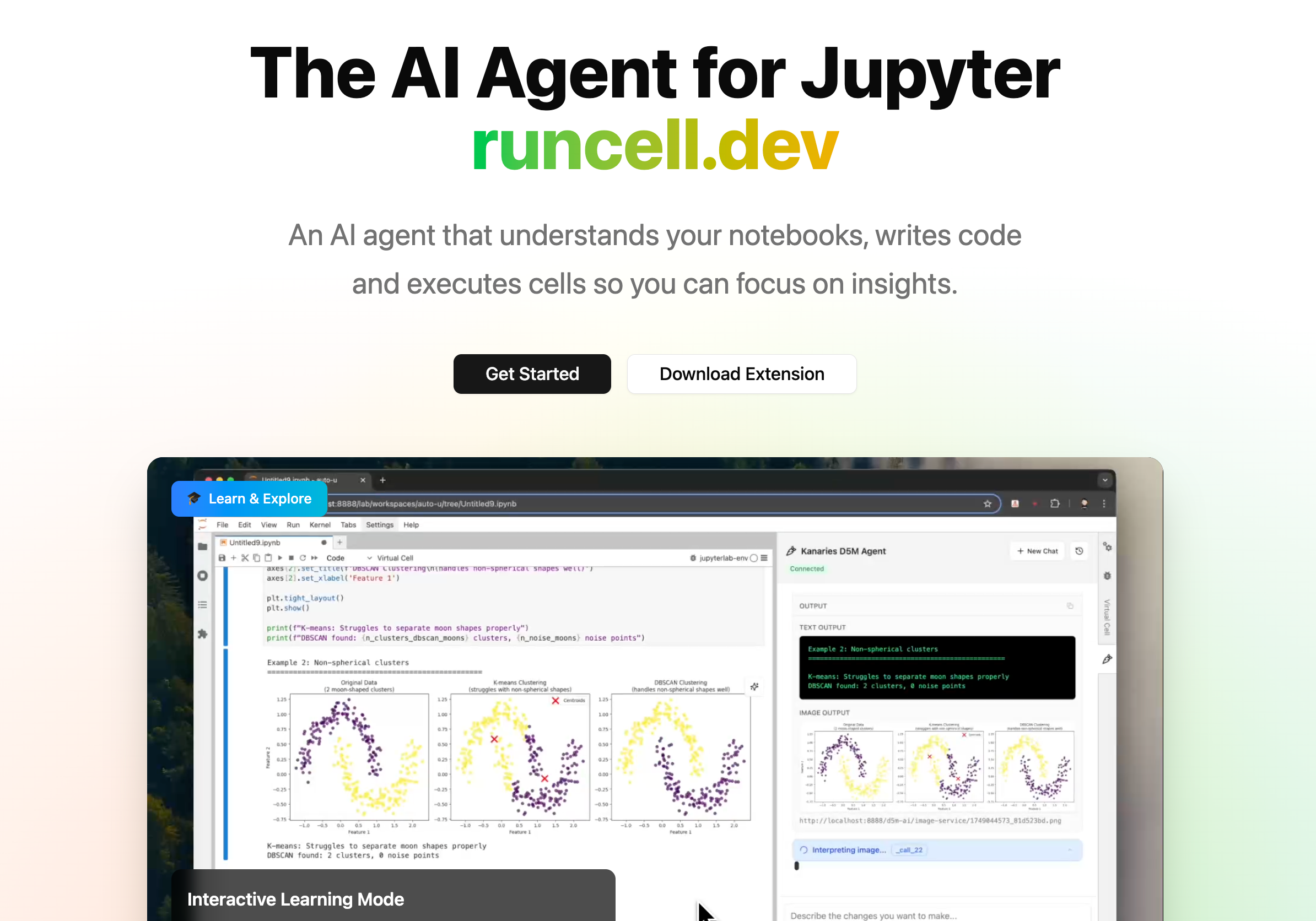
If your day-to-day environment is Jupyter, RunCell (opens in a new tab) is a much more direct fit. It is a data science agent built specifically for Jupyter environments, which is a setting most general agent frameworks still handle awkwardly. Instead of treating the notebook like an external text artifact, RunCell works inside the notebook context itself, which makes it much better at notebook-specific execution loops, stateful debugging, and data-driven analysis.
This is also where the product feels genuinely different from many general agents:
- it is Jupyter-native rather than terminal-native
- it is strong at notebook tasks that require understanding cells, variables, outputs, and DataFrames
- it is unusually useful when the real work is not “run tools forever,” but “reason correctly from data and notebook state”
So if the question in your head is not “which open agent runtime should I bet on,” but “what actually helps me inside a notebook today,” RunCell is probably the more interesting thing to try first.
If you want a more notebook-specific perspective, AI Agent Turns Jupyter Notebook Into a Data Science Co-Pilot is the cleaner next read. If you want the broader coding-tool market context, Best AI Coding Tools in 2026 and Best Vibe Coding Tools in 2026 are the stronger companion guides.
Related Guides
- Best AI Coding Tools in 2026
- Best Vibe Coding Tools in 2026
- Codex vs Claude Code
- Parallel Code Agents
- Jupyter AI RunCell
- OpenClaw Discord Setup
- OpenClaw vs ZeroClaw vs Pi Agent vs Nanobot
- How to Use OpenCode
Sources
- Hermes Agent official repo: https://github.com/NousResearch/hermes-agent (opens in a new tab)
- Hermes Agent architecture docs: https://hermes-agent.nousresearch.com/docs/developer-guide/architecture (opens in a new tab)
- Hermes Agent environments docs: https://hermes-agent.nousresearch.com/docs/developer-guide/environments/ (opens in a new tab)
- OpenClaw official repo: https://github.com/openclaw/openclaw (opens in a new tab)
- Peter Steinberger on joining OpenAI: https://steipete.me/posts/2026/openclaw (opens in a new tab)
- OpenClaw channel routing docs: https://docs.openclaw.ai/channels/channel-routing (opens in a new tab)
- OpenClaw Anthropic provider docs: https://docs.openclaw.ai/providers/anthropic (opens in a new tab)
- OpenClaw OAuth docs: https://docs.openclaw.ai/concepts/oauth (opens in a new tab)
- OpenClaw testing docs: https://docs.openclaw.ai/help/testing (opens in a new tab)
- Anthropic account login/help article: https://support.claude.com/en/articles/13189465-logging-in-to-your-claude-account (opens in a new tab)
- Anthropic Pro or Max Claude Code article: https://support.claude.com/en/articles/11145838-using-claude-code-with-your-pro-or-max-plan (opens in a new tab)
- TechCrunch on Peter Steinberger’s temporary suspension: https://techcrunch.com/2026/04/10/anthropic-temporarily-banned-openclaws-creator-from-accessing-claude/ (opens in a new tab)
FAQ
What is the difference between Hermes Agent and OpenClaw?
Hermes Agent is an integrated agent runtime: one runner, one memory system, one tool registry, exposed through several surfaces. OpenClaw is a gateway-centric assistant platform: channels, session routing, and delivery are the architectural center. Hermes optimizes runtime coherence; OpenClaw optimizes control-plane reliability.
What is Hermes Agent?
Hermes Agent is an integrated agent runtime built by Nous Research. It combines a shared runner with memory, tools, messaging, ACP integration, skills, and automation across multiple surfaces.
What is OpenClaw?
OpenClaw is a personal assistant platform whose architecture centers on a long-running gateway, session routing, channel behavior, and delivery across real communication surfaces.
Is Hermes Agent a direct OpenClaw replacement?
Not exactly. Hermes and OpenClaw overlap enough to be compared, but they optimize for different system boundaries. Hermes is more runtime-centric, while OpenClaw is more gateway-centric.
Why does this comparison matter in 2026?
It matters because OpenClaw has gone through creator and ecosystem changes, and Anthropic has made third-party Claude usage more economically and operationally uncertain. That pushes more users to reevaluate alternative agent stacks.
Is Hermes Agent really “self-improving”?
In the practical sense, yes, but not through live weight updates. Its improvement loop is based on memory, reusable skills, accumulated context, and rollout generation for later training and evaluation.
When is RunCell a better fit than Hermes Agent or OpenClaw?
RunCell is the better fit when your real work happens inside Jupyter notebooks. It is designed for notebook-native execution, stateful debugging, DataFrame-aware analysis, and data-science workflows.